
A plain-English playbook to help get your fintech, bank or SaaS company mentioned by ChatGPT, Claude and Gemini. A white paper from Gallop GTM.
AI assistants decide which companies to mention using two things: what they absorb in training and what they fetch from the web at the moment someone asks. You can influence both, mostly with work that good marketing already requires.
The short version
There are two ways in. An AI model "knows" what it absorbed during training, and it "looks up" what it fetches live from search indexes and web pages. Your visibility depends on both.
Google says this is still SEO. Its AI optimization guide states that generative AI search is built on its core ranking and quality systems. Our read: the fundamentals were not retired, they just got a much bigger audience.
A mention is the new first impression. When an assistant answers "which payments platform should we consider?", the shortlist forms before anyone visits a website.
Trust is the tiebreaker, especially with money involved. Google's systems weigh quality signals more heavily for topics like finance, and Google calls trust the most important of them.
Most "AI hacks" are noise. Google says llms.txt, special markup and content chopped into bite-size pieces are not needed for its AI features. Original expert content, a site machines can read and real third-party validation are what move things.
You can start this week. A ten-play playbook and a 90-day plan are below.
One honest note before we begin: nobody can guarantee a mention in an AI answer. What we can do is show you how the systems work and what is in your control.
What changed: the answer is now the pitch
For twenty years, buyers researched with a list of ten blue links and opened a few tabs. Increasingly, they ask a question and read one written answer.
The click data shows the shift. Pew Research Center tracked the browsing of 900 U.S. adults in March 2025. When a Google results page showed an AI summary, people clicked a traditional result link in 8% of visits. Without one, they clicked in 15%. Only 1% of visits with an AI summary included a click on a link inside the summary. AI summaries appeared in about 18% of the searches Pew analyzed. That is a snapshot of one sample, and behavior has kept moving since, but the direction is hard to miss.
Gartner went further in a February 2024 forecast: traditional search engine volume will drop 25% by 2026 as AI chatbots and other virtual agents take over queries. Treat that as a prediction, not a measurement. It still describes what many marketing teams are feeling.
In plain terms, your buyer's shortlist used to be assembled from search results you could fight for page by page. Now it may be assembled from one paragraph, and you are either named in it or you aren’t. Consideration is happening earlier, inside the answer, before your website ever becomes part of the buying decision.
Gartner's advice seems straightforward: produce unique, useful content that reflects real expertise, experience, authority and trust. Keep that sentence in mind.
The vocabulary, in plain English
The acronyms are the most intimidating part of this topic and can sometimes feel like alphabet soup. Here's the short glossary:
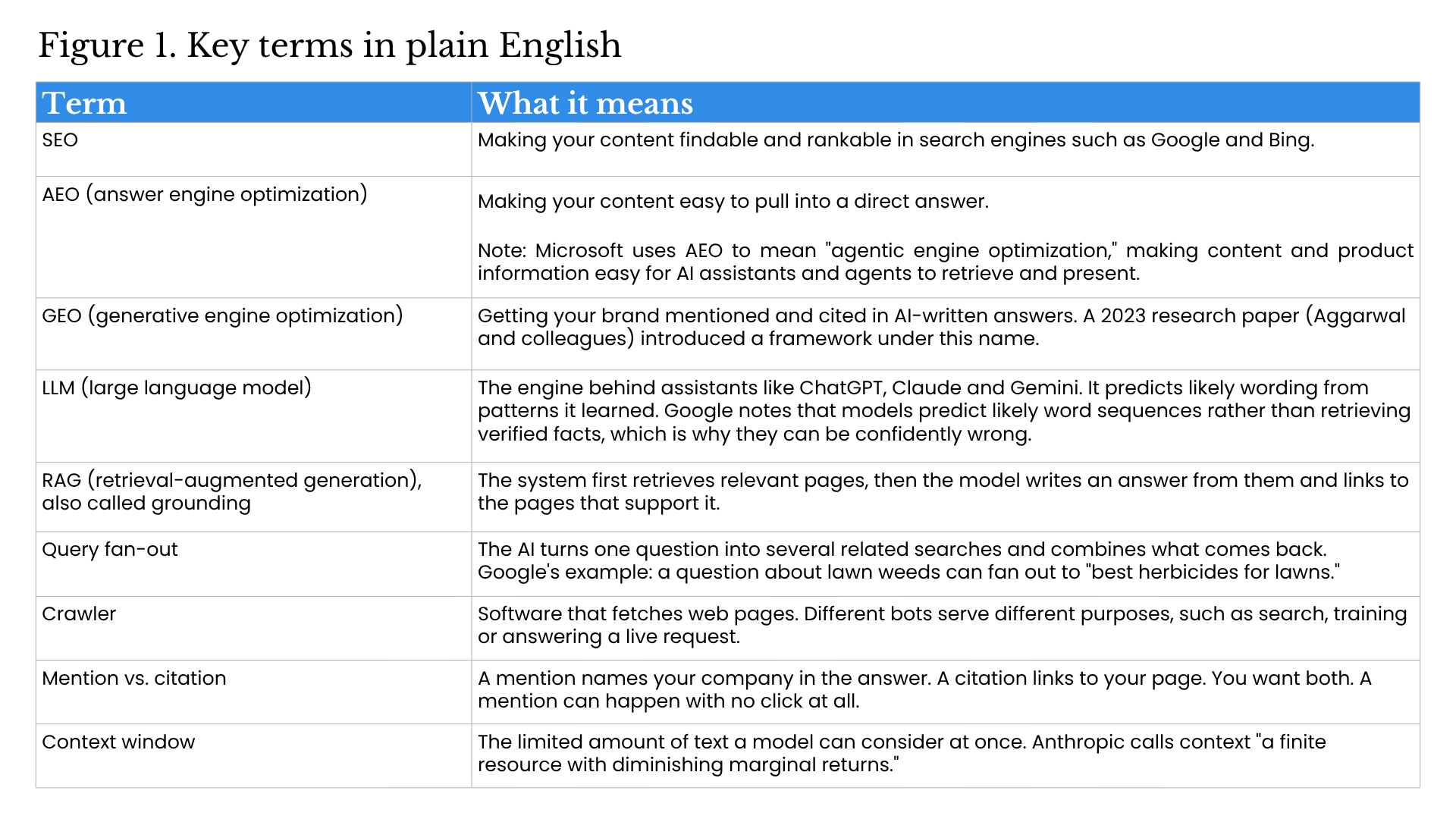
Google's position is that optimizing for generative AI search is still SEO, and it advises evaluating third-party AEO and GEO advice carefully. We agree. Treat the three labels as three goals (be findable, be quotable, be chosen), not three separate disciplines with three separate budgets.
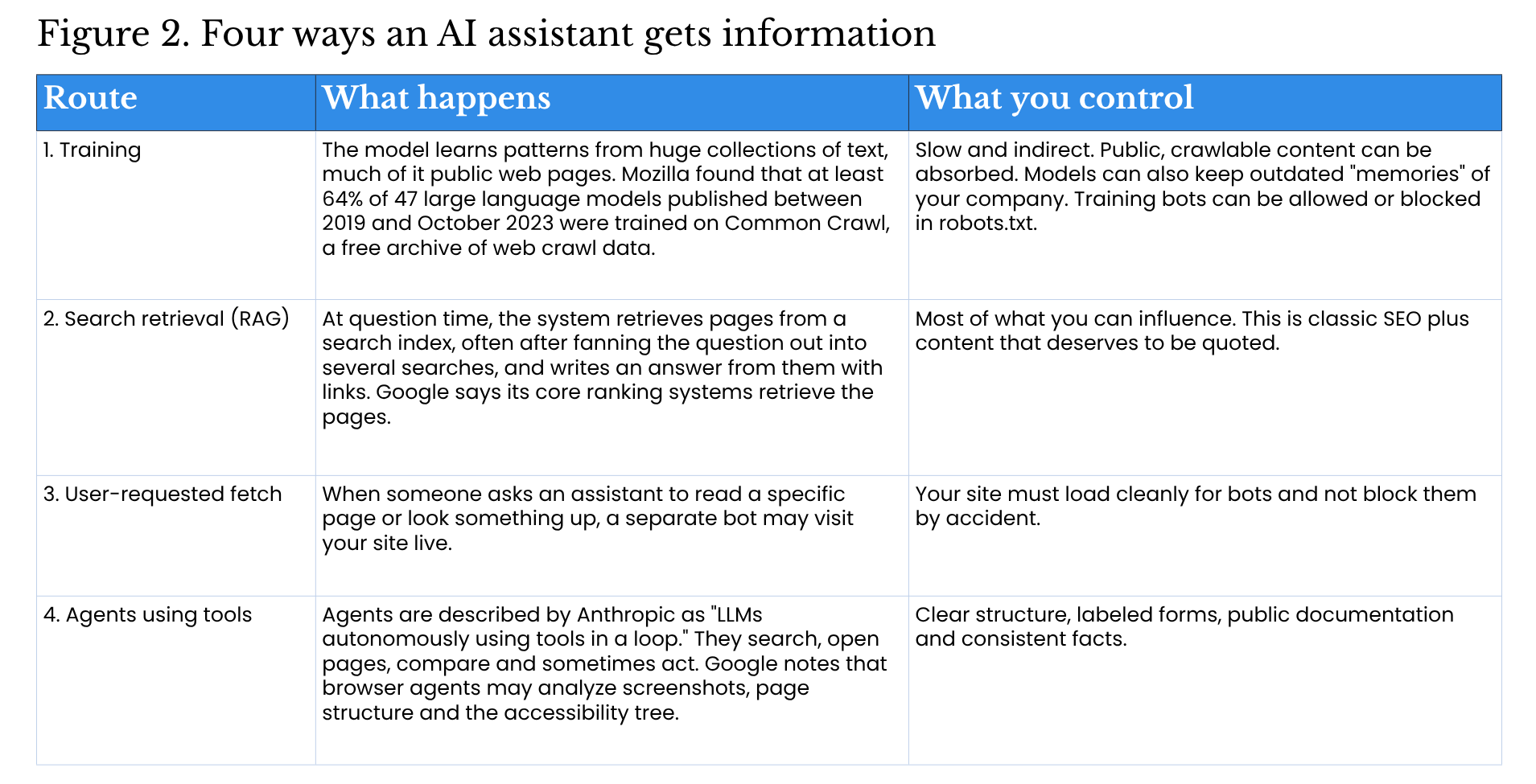
How LLMs pull in information
An AI assistant gets information in four ways. Knowing which one is in play tells you what you can influence.
The bots, and what blocking them does
Your robots.txt file decides which of these bots can read your site. Blocking the wrong one is the fastest way to disappear.
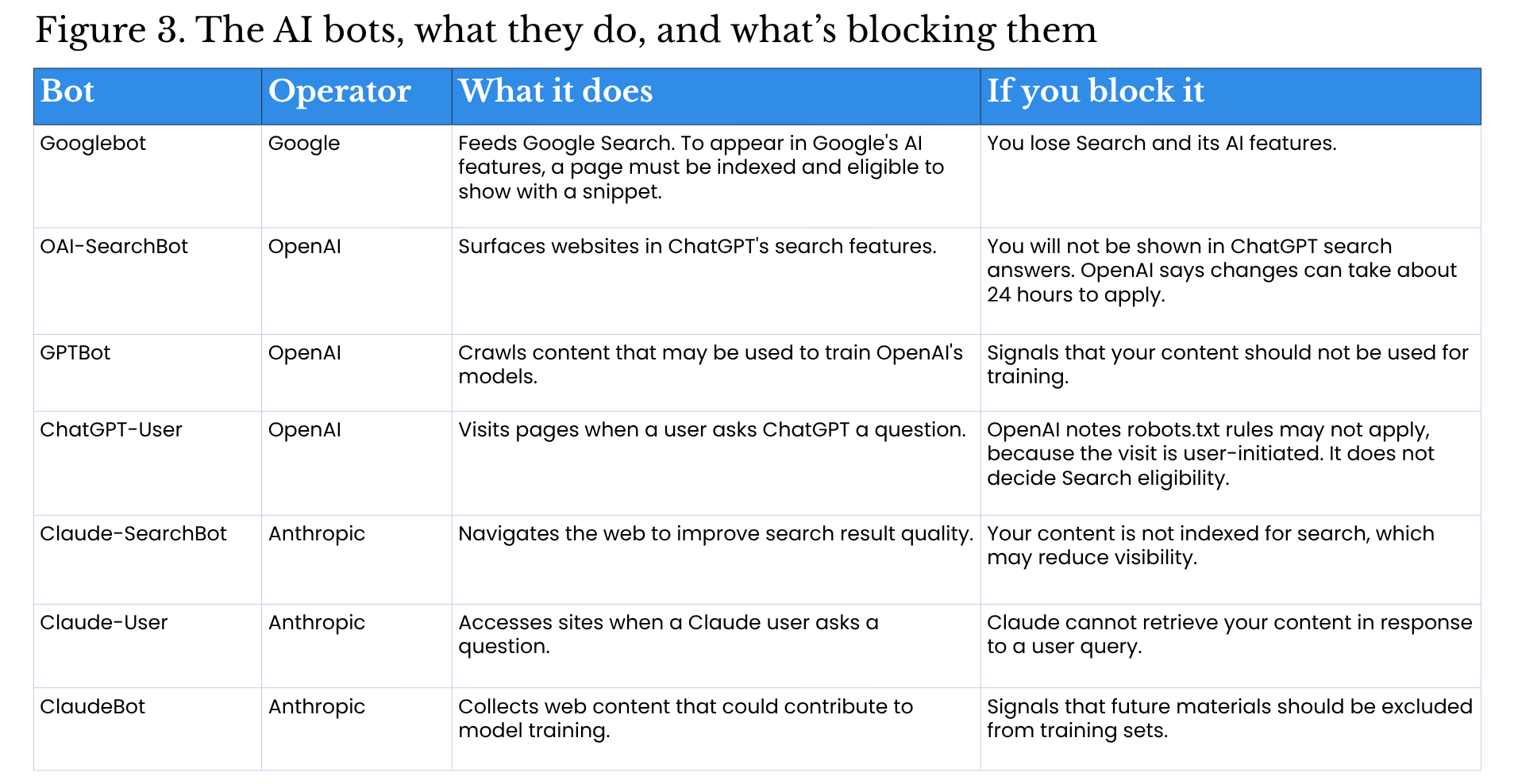
Training and search are separate decisions. A bank might reasonably block training bots and still welcome search bots, or the reverse. What matters is that you decide on purpose. A robots.txt file written in 2019, or a security setting that blocks every unfamiliar bot, may already have decided for you.
Why a model cannot read everything: context engineering
Anthropic's engineering team describes the constraint in its guide to context engineering. A model has an "attention budget." Every extra piece of text draws it down, and as the amount of text in the context grows, the model's ability to recall specific details tends to fall, which Anthropic calls context rot. So well-built systems aim for "the smallest possible set of high-signal tokens" that gets the job done. Agents increasingly keep lightweight pointers such as links and load the detail just in time, instead of stuffing everything up front.
Our takeaway, a page that states its point clearly, in plain language, with specifics, is cheap and useful to work with. A page that buries the answer under 2,000 words of setup and fluff is expensive and easy to skip.
The five steps behind a single answer
The good news, you have control over what information shows up for the AI assistants. It’s important to understand the steps behind a single AI generated answer so you can better serve up a relevant response for the AI assistant to pick up.
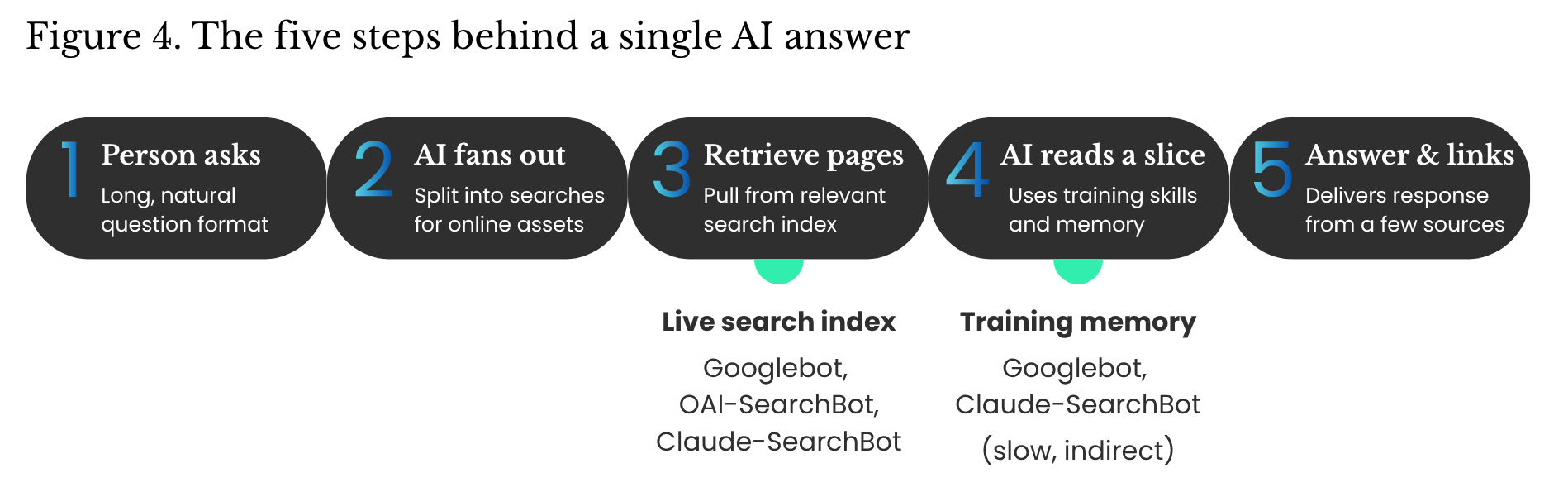
You influence step 3 the most: classic SEO plus content worth quoting. Step 1 is where you win early: map the real questions buyers ask (Play 3). Bots shown are examples; see Figure 3.
A person asks. The question is often long and conversational, such as "Which payment processors support marketplace payouts in Canada and have strong fraud tools?"
The system fans it out. It may split the question into several related searches.
It retrieves candidates. Pages come from a search index. To be considered, yours needs to be indexed and eligible to appear with a snippet.
The model reads a slice, not the whole web. It works from a curated set of retrieved text plus what it learned in training. Models can still misstate what they read, which is why accurate, unambiguous source pages matter.
The answer appears with links. A handful of sources get cited. Most people read the answer and move on.
Who is involved
The AI assistants. Google (AI Overviews and AI Mode), OpenAI's ChatGPT, Anthropic's Claude, Microsoft Copilot, Perplexity and others. Each builds its own retrieval and has its own habits. Ahrefs analyzed about 76.7 million Google AI Overviews and roughly 957,000 ChatGPT and 953,000 Perplexity prompts in June 2025. Wikipedia was the most-mentioned domain in all three (16.3% of ChatGPT mentions, 12.5% in Perplexity, 8.4% in AI Overviews). YouTube was strong in Perplexity and AI Overviews but absent from ChatGPT's top ten, while Reddit and Quora showed up in the top ten only for AI Overviews. The lesson is where you need to show up depends on which assistant your buyer uses.
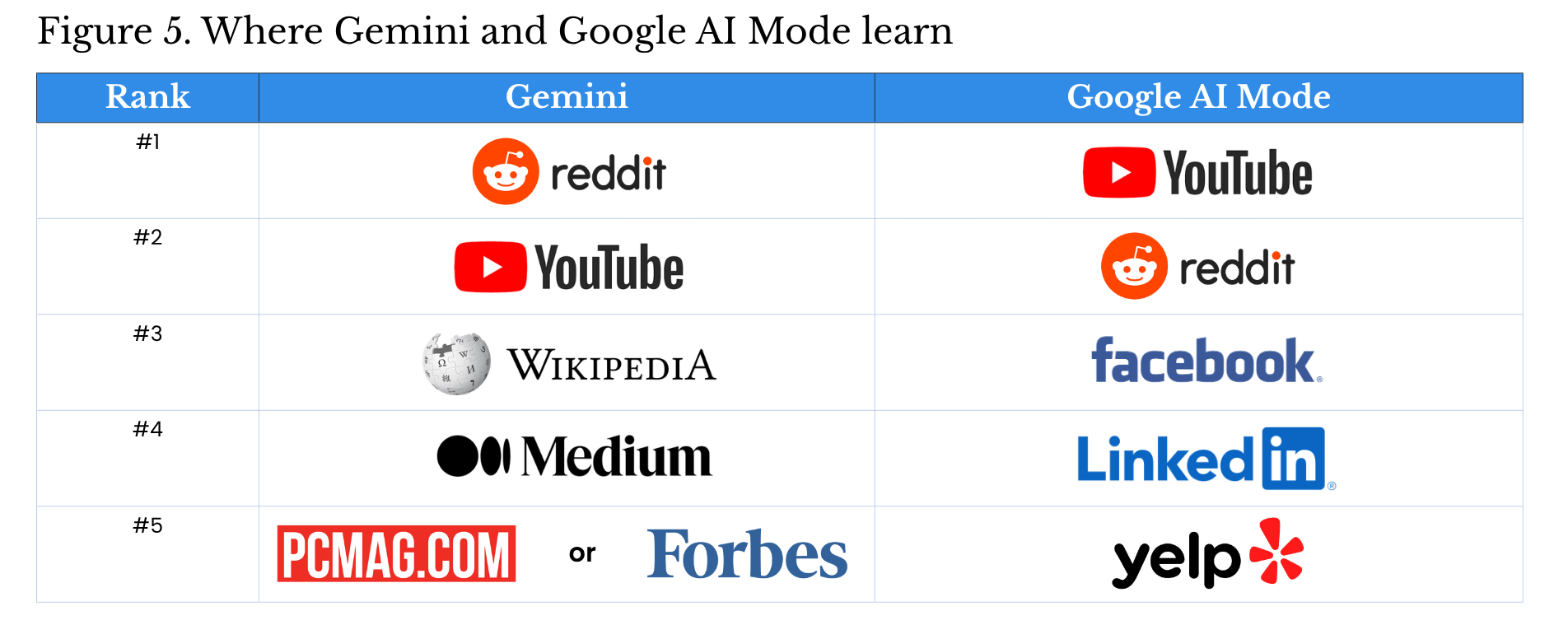
Source: Peec AI, March 2026, 30 million cited sources in the US. Separately, Semrush found LinkedIn was cited in nearly 15% of Google AI Mode responses between July and October 2025.
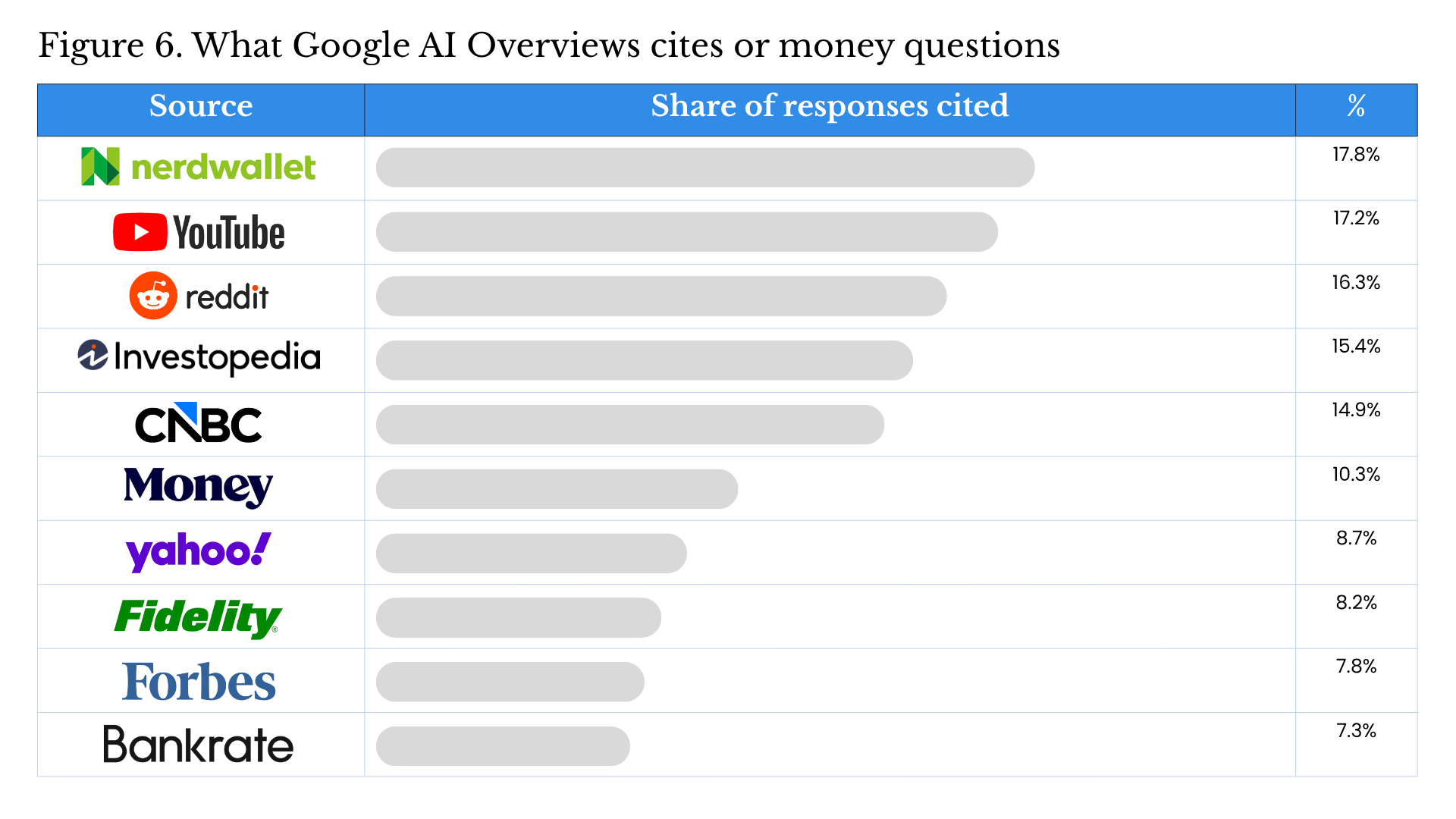
Share of Google AI Overviews responses that cite each domain at least once, for investing, retirement, mortgage and financial decision queries (4,129 responses, July to September 2026). Source: LLM Authority Index. This covers one assistant and one product area, and it is a single vendor's research sample, not a census of real searches.
The full picture: what AI assistants pull from
Reference sites. Wikipedia is the standout on ChatGPT, and a much smaller factor on Google's AI features.
Communities. Reddit appears for every assistant, and Quora shows up on Google AI Overviews. ChatGPT's use of Reddit swung sharply in 2025, so treat community presence as useful but unstable (Semrush).
Video. YouTube is a top source for Google AI Overviews and AI Mode, Perplexity and Gemini.
LinkedIn. Cited across ChatGPT, Google and Perplexity, and the top source on Google AI Mode in Semrush's data. For B2B brands, articles, posts and company page updates all get cited (Peec).
News and editorial. Forbes, Business Insider, Reuters and trade publications. In Muck Rack's study of links cited by ChatGPT, Gemini and Claude, 27% were journalism, rising to 49% when the question asked for recent information.
Review and analyst sites. G2 and Gartner, plus consumer sites like NerdWallet and Yelp where they fit the topic.
Your own website and listings. In Yext's client data, 44% of citations came from brand-owned websites and 42% from listings. For financial services, 48.2% came from brand-owned websites.
Finance publishers. NerdWallet, Investopedia, CNBC, Bankrate and Forbes lead on money questions. In an agency study of wealth management prompts, firms' own city or specialty pages beat national media on local and niche questions (Gregory).
Every study in this section comes from a vendor or agency and measures something slightly different, so treat the numbers as directional. We found no independent study of which sources Claude cites, and no Copilot-specific data.
Your buyers. Executives and practitioners who now research vendors by asking conversational questions: what to shortlist, how two options compare, what a compliance requirement means for a purchase. They are drafting RFPs and prepping for meetings with an assistant open in the next window.
Your own team. This is the part most companies miss. AI visibility falls between brand, SEO, product marketing, content and compliance, so nobody owns it. Somebody should. It is a go-to-market problem, not a plug-in.
Why it matters more for fintech, payments, banking and SaaS
The shortlist forms earlier. With clicks falling when an AI summary appears, the answer does the pitching. If you are not in it, you are not on the list.
High-trust topics get held to a higher bar. Google says its systems give more weight to quality signals such as experience, expertise, authoritativeness and trust for topics that could affect people's finances. It calls trust the most important of these, and warns that "any form of deception makes a page untrustworthy to both users and our automated quality systems." Generic, thin content on a money topic does not just underperform. It gets filtered out.
Mistakes are expensive. Because models predict likely wording, they can misstate fees, regulatory status, supported regions or integrations. If you have not published clear, current facts, the system fills the gap with whatever it finds, including a competitor's framing or a three-year-old review.
Commodity content is the easiest to replace. Gartner expects search systems to weigh content quality more heavily as AI-written content floods the web. If a competitor could publish your page by swapping the logo, an AI can summarize it without needing you.
What Google actually says: myths and reality
A whole cottage industry has grown around AEO and GEO, and some of it is a tip jar. (Yes, we are a go-to-market firm telling you this. It is exactly why we are telling you.) Google has published plain guidance, so start there. If someone sells you a secret AI ranking trick, ask them for the Google documentation page that says so.
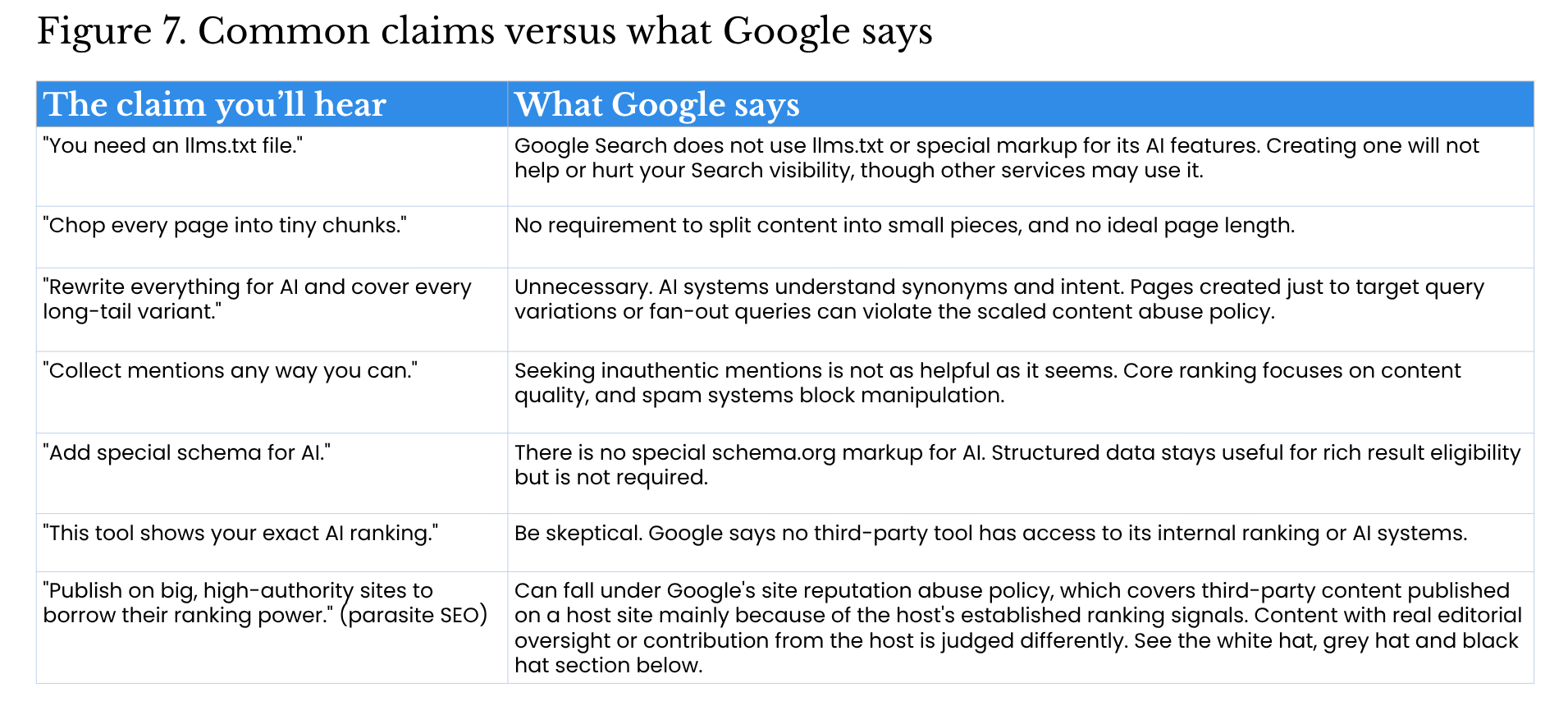
White hat, grey hat and black hat SEO explained
You’ll likely hear these three labels when you start talking to anyone who focuses on SEO. They are industry shorthand, not Google terms.
White hat. Work that helps people first and follows the search engines' published guidelines: original expert content, a technically healthy site and honest, earned mentions. It is slower, but it’s also the version that holds up when an algorithm or an AI system changes.
Grey hat. Tactics that are not clearly banned but sit close to the line and depend on the rules staying vague. Think of changing the dates on old articles without really updating them, paid placements that read like editorial, or publishing expert content on a third-party site mainly to borrow the host's authority. Our read: this label is a judgment call, not a rule, and two honest experts can disagree on where a tactic lands. Grey tactics have a way of turning black after a policy update.
Black hat. Techniques built to deceive people or manipulate rankings. Google names several in its spam policies: scaled content abuse ("many pages are generated for the primary purpose of manipulating search rankings and not helping users"), link spam (for example, "buying or selling links for ranking purposes"), expired domain abuse (repurposing an expired domain mainly to manipulate rankings) and site reputation abuse, covered next. Violations can lead to lower rankings or removal from results, and for a regulated company the reputation and compliance damage can outlast the penalty.
Where parasite SEO lands. Parasite SEO means publishing content on a high-authority site you do not run, mainly to borrow its ranking strength. Google's site reputation abuse policy applies "where third-party content is published on a host site mainly because of that host's already-established ranking signals, which it has earned primarily from its first-party content." Its review looks at whether the content has "sufficient input, editorial oversight, or contribution from the host site." Our read: a real contributed article that a publication's editors commission and stand behind is white hat, low-quality pages dropped onto a big domain to piggyback on its authority are black hat, and everything in between is grey. For fintech and banking, we would stay well clear of the grey. A borrowed page is also a fragile place to build a reputation, because you do not control it and the host can remove it.
A simple gut check: would you be comfortable explaining the tactic to a regulator, a customer and a journalist at the same time? If not, skip it.
What Google says does work
A unique point of view. First-hand experience beats a summary of what already exists. Generic listicles built on common knowledge add little.
Content organized for readers. Clear paragraphs, sections and headings, with images and video where they help.
A technically healthy site. Public, crawlable, indexed and eligible to show a snippet, with good page experience on every device.
People-first purpose. Google's test: is this content my visitors would find satisfying?
Measurement through the source. Search Console has a Generative AI performance report showing how your content performs in AI features in Search and Discover.
Using AI to make your content
Google's position is practical. Generative AI is fine for researching and structuring original content. Mass-producing pages without adding value for users may violate its scaled content abuse policy. Fact-check and review everything, including titles, meta descriptions, structured data and image alt text. And apply Google's "who, how and why" test: make the creator clear with real bylines (never invented personas or credentials), explain how the content was made where readers would wonder, and be sure the reason it exists is to help people.
Our take: Most teams use AI in one of two ways. Some fully rely on what it creates and publish whatever comes back. Others barely use it, or use it so cautiously that it saves almost no time. The 20-60-20 approach is a simple middle path, and it has become a popular way to describe how to get real value from AI without giving up quality.
The idea is a division of labor. A human spends the first 20% of a task on direction and strategy detailing the goal, audience, context, and standard for "good." Then, AI does about 60%, the drafting and heavy lifting. To wrap it up, a human spends the last 20% fact checking, fixing the voice, and adding the judgment only your team has.
The playbook: ten plays to get mentioned
None of these plays is a trick. That is the point. They are the work that makes a company easy to find, easy to understand and easy to trust, for people and for the systems that serve them. The order matters: readable first, then quotable, then trusted.
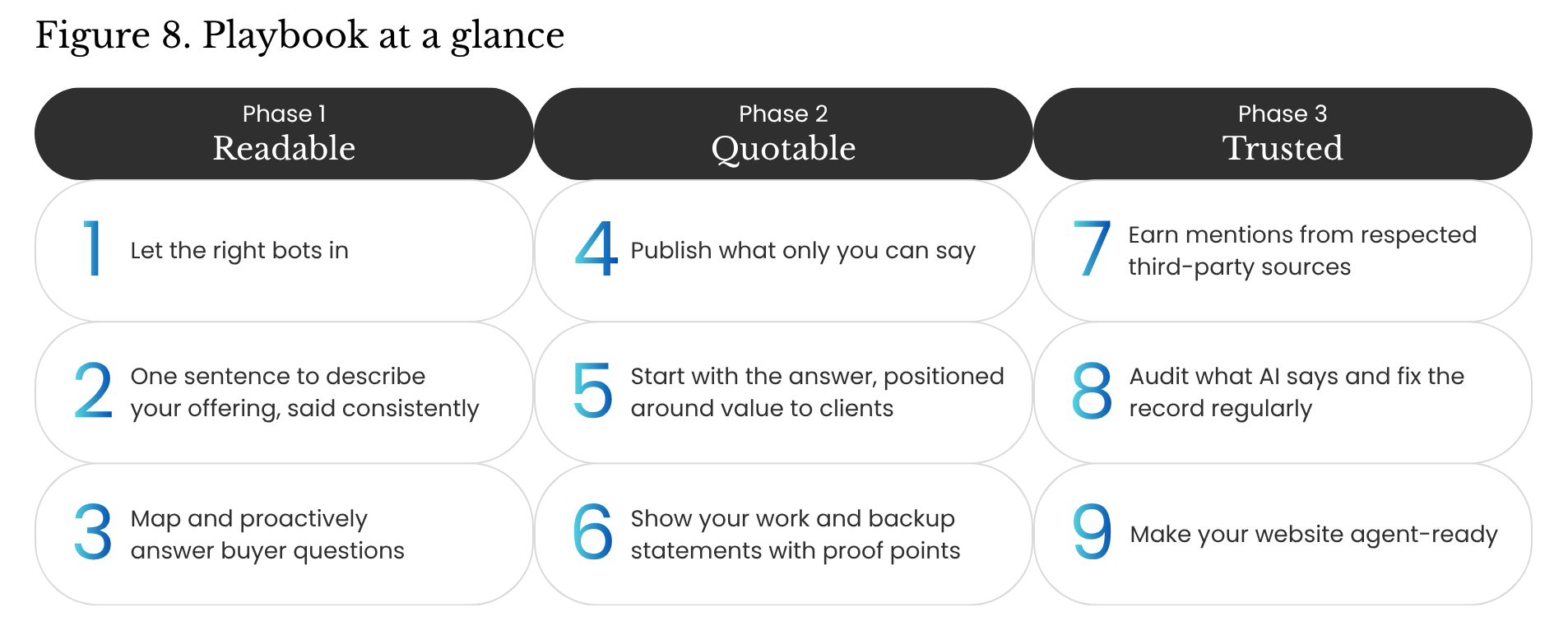
Phase 1: Be readable
Play 1. Let the right bots in, and decide on purpose. Check your robots.txt file, your CDN and firewall bot rules, and any no-index tags. Confirm key pages are indexed and eligible for a snippet by verifying your site in Search Console. Keep your useful content in HTML pages, not only in gated or locked PDFs. Then make training and search separate decisions (see Figure 3 above).
Play 2. Say who you are in one sentence, the same way everywhere. Name, category, who it is for, what it does and one proof point. Match it across your website, LinkedIn page, review profiles, marketplace listings, press boilerplate and documentation. Systems reconcile many sources, and inconsistent descriptions can produce inconsistent answers. A solid positioning strategy and framework is the key here. If your team still debates it quarterly, start there.
Play 3. Map the questions buyers ask, then answer them on purpose. Collect them from sales calls, support tickets, RFPs and search data: comparisons, pricing logic, security and compliance, integrations, implementation, "best for" and "alternatives to." Because assistants fan questions out into smaller ones, the quality of your answers to the small questions matters. Write one strong page per real question. Do not mass-produce variations. Google calls that scaled content abuse.
Phase 2: Be quotable
Play 4. Publish what only you can say. Original data, benchmarks, implementation lessons, product teardowns and regulatory interpretation from your named experts. Run the logo test: could a competitor publish this page by swapping the logo? If yes, it will likely won’t earn a mention.
Play 5. Put the answer first. Lead with the direct answer in plain words. Use descriptive headings, short paragraphs and tables for comparisons, and define jargon the first time it appears. Google says no special formatting is required and there is no ideal length, so this is about clarity for people, which also happens to be what a system with a limited attention budget handles best.
Play 6. Show your work. Put a real, named author with credentials on every substantive piece. Cite sources. Add a published and last-reviewed date. Include specific numbers and, where you have them, quotes from customers and experts (with permission). Never invent authors, headshots or credentials.
Phase 3: Be trusted
Play 7. Earn mentions where buyers and machines look beyond your site. Analyst briefings, review sites, partner and marketplace listings, industry press, conference talks, podcasts and customer stories. Different assistants lean on different sources, as the Ahrefs data shows. Earn these honestly. Google says inauthentic mentions are not as helpful as they seem, and spam systems are built to catch them. If a mention would embarrass you in a screenshot, skip it. Be careful with borrowed authority. Publishing content on a high-authority site you do not run, mainly to rank off that site's reputation (often called parasite SEO), can run into Google's site reputation abuse policy. A contributed article that a publication's editors truly commission and review is a different thing. See the white hat, grey hat and black hat section above.
Play 8. Audit what AI says about you, then fix the record. Build a set of 25 to 50 prompts that cover buyer stages: category questions, comparisons, "alternatives to [competitor]," and compliance questions. Run them monthly in the major assistants. Log whether you are mentioned, whether it is accurate, which sources are cited and which competitors appear. Fix errors at the source, starting with your own pages. Publish a plain, current facts page covering what you offer, supported regions, certifications and pricing model. Rerun the prompts after changes.
Play 9. Make your site usable by agents. Google notes browser agents may read screenshots, page structure and the accessibility tree, so use real links, labeled form fields and accessible markup. Keep public documentation and API references easy to reach. Keep data consistent and current everywhere it appears. Microsoft's guidance for AI shopping experiences stresses machine-readable, consistent, up-to-date information that matches what users see on the page.
Measure honestly and keep humans in the loop. Use the Generative AI performance report in Search Console. Watch analytics for referrals from AI assistants. Track your prompt set over time. Add "how did you hear about us?" to forms and ask sales to log "an AI told me." Have a subject matter expert and compliance review anything AI-assisted before it publishes (bonus points if you train your AI to proactively adhere to subject matter expert and compliance expectations). Treat any tool or vendor that promises a guaranteed rank or mention with the skepticism.
What to avoid
Mass-produced AI pages with little original value.
Fake authors, fake reviews or bought mentions.
Keyword stuffing. The research found it performed poorly.
Exaggerated or misleading claims that can reduce trust and limit visibility.
Locking every useful answer behind a form.
Parasite SEO: low-value pages placed on someone else's high-authority site mainly to borrow its rankings.
A 90-day plan and a self-scorecard
We cannot promise a mention in 90 days. We can promise a measured baseline, better answers on the pages that matter and a clear read on what moved.
Days 1 to 30: Foundation
Check bots, indexing and site readiness, and decide your bot policy on purpose.
Agree one positioning sentence and map the top 25 buyer questions to pages.
Run your prompt set in the major assistants to get a baseline.
Done when: you have a baseline report and a ranked list of gaps and fixes in the team's backlog.
Days 31 to 60: Create
Publish 4 to 6 pages that answer the highest-value questions, with original proof, named authors, dates and sources.
Publish a facts page.
Fix the factual errors the baseline exposed.
Done when: new pages are live, indexed and reviewed by an expert and compliance.
Days 61 to 90: Earn and measure
Pursue 3 to 5 third-party opportunities such as analyst briefings, review sites, partners and press.
Collect permissioned customer stories.
Rerun the prompt set, compare it to the baseline and report.
Done when: you have a before-and-after report and a plan for the next quarter.
Self-scorecard
Be honest. Nobody is grading this but the assistants.
☐ Our key pages are indexed and eligible for snippets, and we checked in Search Console.
☐ We chose our training-bot and search-bot policies on purpose.
☐ Anyone on the team can say what we do and who it is for in one sentence, and our site, LinkedIn page and review profiles agree.
☐ We keep a list of the top 25 questions buyers ask and know which page answers each one.
☐ We publish at least one thing a quarter that competitors cannot copy, such as data, a benchmark or hard-won lessons.
☐ Every substantive article has a named author, a date and sources.
☐ Compliance reviews our claims before they publish.
☐ We ran our buyer questions through at least three AI assistants this quarter and logged the results.
☐ We know where analysts, review sites, press and partners describe us, and those descriptions are accurate.
☐ One named person owns AI visibility.
8 to 10 checked: you’re ahead of most of your market. 4 to 7: you have a plan to write, and it is a good one. 0 to 3: you are invisible by default, which is annoying and entirely fixable.
How Gallop GTM can help
AI visibility is not a bolt-on. It is positioning, proof and distribution, which is up front go-to-market work. That is the work we do, and we understand companies in complicated, regulated markets where a generic pitch does not survive interactions with a skeptical buyer.
To say who you are, clearly and consistently: Positioning Workshop. We settle your customer, your competitive alternatives, your value and your category, so every page, profile and answer starts from the same sentence.
To see where you stand against competitors: Competitive GTM Review. We look for the openings your competitors have left, including how the leading AIs describe you and them today.
To turn this paper into a plan your team can run: GTM Strategy Sprint. Two weeks, a defined audience, positioning, channel mix and a dated launch sequence with owners.
To create content worth quoting: Content & Campaigns, Campaign Anchor Piece and Sales Collateral. Original, expert-led pieces and proof points built from what your buyers ask and what your reps hear.
To have an experienced owner for all of it: Advisor, Growth Partner or GTM Lead. Strategic guidance, hands-on partnership or fractional CMO-level ownership, at the level your stage needs.
We're here to help. If you are not sure where you stand, email hello@gallopgtm.com and ask for a first look at how the major assistants describe your company. Or reach out to Gallop GTM to talk through the playbook. We would love to help you get found, quoted and chosen.
Legal disclosure
This white paper is for general information and education. It is not legal, financial, regulatory, or compliance advice. Rules for fintech, payments, banking, and SaaS vary by region and change often, so check your plans with your own legal and compliance teams before acting.
The statistics and findings come from third-party studies, most of them by vendors and agencies, measured in different ways at different times. We cite each one and have not independently audited them. AI assistants and search engines change often, so your results will differ, and nothing here guarantees rankings, citations, mentions, traffic or revenue.
Company, product and platform names are the property of their respective owners and appear here for identification only. Their use does not imply any affiliation with, or endorsement by, Gallop GTM.
Sources
All web pages below were opened and read on October 15 or 16, 2026. Guidance from Google, OpenAI and Anthropic changes often, so check the originals before acting.
Google Search Central, Optimizing your website for generative AI features on Google Search
Google Search Central, Google Search's guidance on using generative AI content on your website
Google Search Central, Creating helpful, reliable, people-first content
Google Search Central, Spam policies for Google web search
Anthropic Engineering, Effective context engineering for AI agents
OpenAI, Overview of OpenAI crawlers
Anthropic Help Center, Does Anthropic crawl data from the web, and how can site owners block the crawler?
Pew Research Center, Google users are less likely to click on links when an AI summary appears in the results (July 2025)
Gartner, Gartner Predicts Search Engine Volume Will Drop 25% by 2026, Due to AI Chatbots and Other Virtual Agents (February 2024)
Mozilla Foundation, Training Data for the Price of a Sandwich: Common Crawl's Impact on Generative AI (February 2024)
Ahrefs, Top 10 most cited domains by AI assistants (June 2025)
Aggarwal et al., GEO: Generative Engine Optimization, arXiv preprint (2023, revised 2024)
Profound, AI platform citation patterns (June 2025, updated August 2025)
Peec AI, Top domains cited by AI search: analysis based on 30M sources (March 2026)
Semrush, Most-cited domains in AI search (November 2025)
LLM Authority Index, The 100 most-cited websites in Google AI Overviews for high-stakes investing, retirement, mortgage and financial consumer decisions (updated October 2026)
Muck Rack, What Is AI Reading? report, as summarized by Page (September 2025)
Yext, Yext Research: 86% of AI citations come from brand-managed sources (October 2025)
Gregory, New study of 200,000+ AI citations reveals which sources drive wealth management visibility in AI search (March 2026)
Search Engine Journal, A breakdown of Microsoft's guide to AEO and GEO.